Wild Soccer Bunch
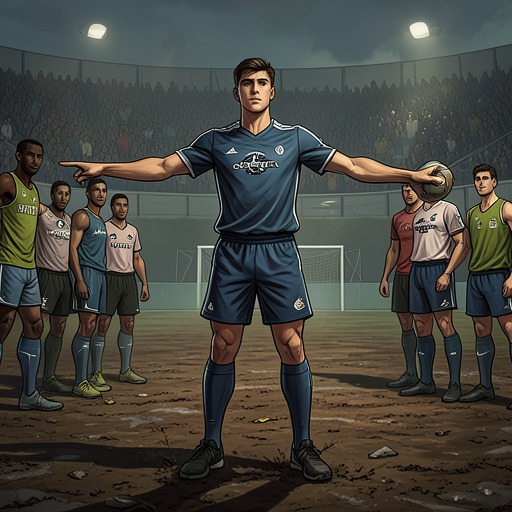
Kevin the Star StrikerWild Soccer Bunch is the collective team identity formed by Kevin, his friends, and Sox. It signifies more than eleven boys and a dog who enjoy soccer: it names a group that becomes “dangerous and wild” through loyalty, training, courage, and mutual dependence. Its decisive achievement is to turn a scattered set of players facing exclusion from their neighborhood soccer field into a genuine team capable of challenging the Unbeatables and winning the right to return.
Identity and Formation
The team is introduced through Kevin’s direct account of who belongs to it. Kevin identifies himself as one of the Wild Bunch and presents the group as “eleven friends and a cute dog,” while immediately rejecting the idea that this is merely a harmless children’s team. The Wild Bunch is “much more”: its members are wild, dangerous, and bound together by a shared passion for soccer. Sox, Kevin’s dog, is part of that identity rather than a decorative mascot; he runs among the players during their passing work and participates in the team’s distinctive social world, even when his patience with the exercise finally runs out.
The group’s internal structure depends on different abilities rather than interchangeable players. Danny is Kevin’s best friend and the world’s fastest right forward, a player on whom Kevin says he completely relies. Tyler, Kevin’s older brother and the team’s number 10, is both the team’s brain and its heart because he never gives up. Kyle is a natural goalkeeper who repeatedly escapes his parents’ expectations that he should become a golf or tennis champion in order to play in goal. These descriptions establish the Wild Bunch as a coordinated unit whose strength comes from contrasting roles, personal loyalties, and the players’ commitment to the game.
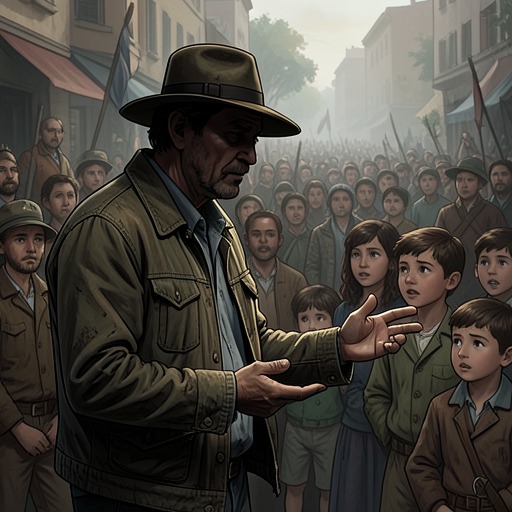
Larry provides the adult center of that identity. Although he works at the lemonade stand beside the soccer field and did not get as far in life as he might have, he was almost a professional soccer player and is regarded by the children as the greatest coach in the world. His authority is therefore not based on status or wealth but on experience, judgment, and the trust he earns from the players. Under Larry’s guidance, the Wild Bunch becomes more than a group that happens to play together: it becomes a team with a shared name, shared discipline, and shared purpose.
The Field, the Threat, and the Challenge
The Wild Bunch’s formation occurs under unusually hostile conditions. Winter extends into April in the north side of Chicago, leaving the neighborhood ground frozen and covered in snow while the wind gives the city its name, The Windy City. The players look toward Spring break as a promised period of uninterrupted soccer, imagining days spent at the field from breakfast until sunset, with Larry’s lemonade during breaks. Their desire to play is therefore tied to a particular place and season, but that anticipated freedom is threatened by Mickey the Bulldozer and his Unbeatables.
Mickey is presented as the defining enemy of the team’s early existence. He appears at the gate with a group of larger, stronger, and more intimidating boys, and Kevin compares his authority in their world to Darth Vader’s. Mickey’s physical presence, his followers, and his contemptuous language turn the soccer field from a shared neighborhood space into contested territory. He announces that the field belongs only to the Unbeatables and orders the smaller players to leave. The Wild Bunch is thus created not in a neutral sporting environment but in response to an act of exclusion.
Kevin answers the occupation with the challenge that gives the team a concrete collective objective. He gives Mickey two weeks, then proposes a soccer match: if the Unbeatables win, they can keep the field; if the Wild Bunch wins, Mickey and his followers must leave and the field will belong to the Wild Bunch forever. Kevin’s defiance is reckless enough to make his friends wonder whether he is suicidal or crazy, but it transforms fear into a public commitment. The team now has a deadline, an opponent, a prize, and a rule-based way to contest power rather than merely endure intimidation.
Trust, Training, and the Battle Cry
The team’s preparation is built around a difficult lesson: fear cannot simply be denied. When Diego asks what the players should do about their fear, Larry answers that fear is their strength. He explains that their awareness of danger gives them a chance, but the players initially do not understand him. Larry also insists that coaching can work only through complete mutual trust: if they want him as their coach, they must trust him one hundred percent, and he must trust them to the same degree. The Wild Bunch’s identity therefore rejects the Unbeatables’ model of effortless toughness. The team does not become strong by pretending that fear is absent; it becomes strong by recognizing fear and acting together anyway.
Training converts that principle into repeated collective movement. During a passing exercise, the ball travels through the players’ ranks under Larry’s instructions, reaching the seventh and eighth passes, then the ninth and tenth. Sox runs between them but cannot prevent the sequence from continuing; after seventeen passes, he yelps angrily, covers his eyes with his paws, and gives up on soccer for the day. The scene is comic, but it also marks a technical and emotional breakthrough. The players run toward one another, embrace each other and Larry, and form their circle for the first time.
Larry counts to three, and without discussion the players produce the phrase that becomes their battle cry: “ONE, TWO, THREE WILD!” The chant gives the team a repeatable public form. It is no longer only Kevin’s description or Larry’s coaching project; it is a ritual voiced by everyone. Its meaning becomes clearest when Mickey’s mocking bark interrupts the celebration and the Unbeatables surround them. The Wild Bunch’s circle and battle cry answer that encirclement with solidarity, turning a vulnerable collection of players into a visibly unified side.
The Comeback and Collective Victory
The decisive match is narrated through rapid passes, shifting attacks, injuries, saves, and a constantly changing score. After the battle cry, Kevin passes to Alex, Alex plays back to Tyler, Tyler sends the ball toward Danny, and the attack moves through Joey before Octopus stops Kevin’s shot. The Unbeatables respond with physical power and immediate pressure. Mickey scores repeatedly, while Julian struggles against Kong and the rest of the Wild Bunch is left battered on the grass. At one point Mickey has scored five goals in seven minutes, while Julian’s eye is discolored, Tyler holds his ribcage, and Kevin has a badly scraped knee.
The team’s response is not a sudden disappearance of weakness but a reorganization of its play. Tyler draws defenders before passing to Danny; Kevin gives up a tempting shot and heels the ball back to Alex; Julian, previously frightened, reappears as an all-in-one defender who seems to be everywhere; and Joey converts pressure into goals. These actions show the team learning to trust the pass rather than rely on a single player’s glory. Kevin’s bicycle kick makes the score seven to two, but the larger transformation is tactical: players begin using one another’s strengths instead of treating the match as a series of individual contests.
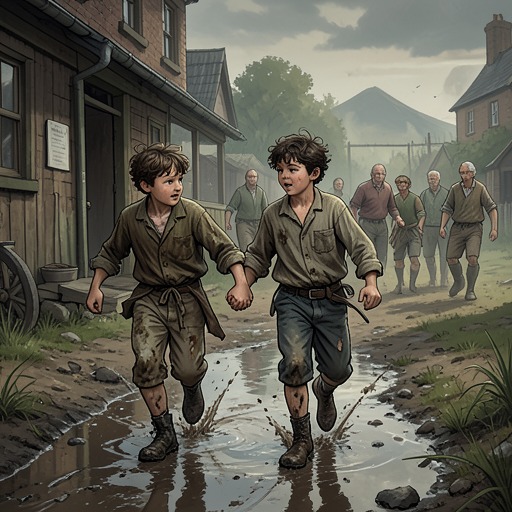
Rain changes the field when the score reaches seven to four. The ground becomes soft and muddy, and the Unbeatables slide around like ducks on an ice rink. The Wild Bunch, however, has practiced on that kind of surface for twelve days. Kevin scores his third goal for a hat-trick, Danny adds his second, Joey makes the score seven to seven, and Tyler scores from halfway down the field when a gust of wind carries the ball beyond Octopus’s reach. Diego then forgets his asthma and becomes the Tornado again as the team takes a ninth goal and believes it has won.
The apparent victory exposes the remaining danger inside the Wild Bunch. Kevin loses the ball because he refuses to pass, wanting the tenth goal for himself, and Larry removes him from the field in favor of Roger. Kevin protests that the substitution will make them lose. The Unbeatables narrow the gap, Roger misses a chance, and the Grim Reaper equalizes the score at nine to nine. The match becomes a test not only of skill but of whether Kevin can surrender individual control. Even after Kevin promises Larry that he will pass, the final breakthrough comes from Roger, who ignores Kevin’s instruction, strikes the ball, and scores the winning goal.
The victory is therefore collective in a precise sense. Roger, previously uncertain and afraid of being responsible for defeat, becomes the player who decides the match. Kyle prevents the Unbeatables from scoring by twice making crucial saves, including a nosedive stop and a last-second deflection around the post. Kevin contributes attacks and goals but must also be disciplined for selfish play. When Roger scores, the team falls over one another, carries him on its shoulders, and runs across the field. The Wild Bunch wins not because one superior hero overwhelms Mickey, but because its members persist through pain, pass under pressure, trust unexpected teammates, and accept a victory that belongs to all of them.
Meaning and Continuing Identity
The Wild Bunch’s victory reverses Mickey’s declaration that the field belongs only to the Unbeatables. The team’s challenge has converted possession into a matter of publicly accepted conditions, and the final result restores the field as a shared home for the players. The group’s identity is consequently both athletic and territorial: to be Wild Bunch means to defend the right to play together.
Its most important contrast is with the Unbeatables’ version of strength. Mickey’s group relies on size, intimidation, mockery, and the claim that fearlessness belongs to the physically dominant. The Wild Bunch initially speaks in similarly aggressive terms, calling itself dangerous and wild, but its actual method becomes different. Its players acknowledge fear, accept coaching, repair breakdowns through passing, and make room for a frightened teammate such as Roger to become decisive. In this sense, the team’s toughness is cooperative rather than solitary. Courage is not the absence of vulnerability; it is the ability to remain connected while vulnerability is visible.
The closing material also points beyond the team’s original all-boy formation. A later account introduces Zoe, a ten-year-old who dreams of becoming the first woman to play for the United States men's national soccer team and hopes to join the Wild Soccer Bunch. She would be the only girl on the team, and the group is described as not yet open-minded about welcoming girls. The possibility of Zoe’s inclusion exposes a limit within the Wild Bunch’s identity even as it promises change: a team founded on shared belonging must decide whether “wild” means defending an established circle or expanding it. The Wild Soccer Bunch therefore ends its first major victory as both a completed team and an unfinished social idea.